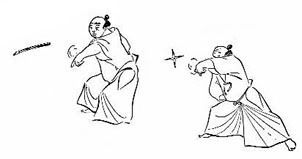
21 - Suriken Jutsu


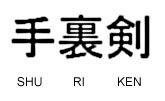
In the Japanese language Shuriken signifies:


Shu Hand
I laugh That also read itself ura - back, in the environment of, in, reverse, interior, palm, behind, lining, wrong side.
Ken That also read itself Tsuguri - sword, sword, sheet, hand of clock.

There are two basic kinds of shuriken: bo shuriken (thin and long sheets) and hira shuriken, or shaken (sheets barges, or in form of star or diamond).

The basic approach of throw the shuriken varies of a school for another one, being the main differences in the form of the sheets and in his use.
Second the text of contribution of the school of Susumo motoshima of the Japan, the origin of the throwing of small sheets comes from the Ganritsu Ryu, founded by Matsubayashi Henyasai, a professional swordsman to service of the 18o. mister of Matsuhiro, in Kanei, about 1624. That school originated the Katono, or Izu Ryu, founded by a samurai of Sendai, called Fujita Hirohide of Katono, also known as Katono Izu, student of Matsubayashi.


Second Motoshima sensei, this was the style that influenced the main schools of Bugei, being the road of origin of the practices studied in the Kaze in the Ryu Bugei.

He was pioneer in the launching of needles, with around 10cm and 20g, many of the which he used in their hair. The needle was insured between the medium finger and the indicator and thrown like a modern dart, in the eyes of the opponent. It said itself that he could throw two needles simultaneously to the figure of a horse, and set right each one of his hooves.

According to the contribution of Iwasaki sensei many were the styles that it leave then arose in the Japan old as by example:

Enmei Ryu
The famous swordsman Miyamoto Musashi is had like founder of that school, that studies the launching of a sheet of 40cm, probably a "so much" (knife). There is a history of a duel between Musashi and Shishido, expert in Kussari-Range (weapon developed for defense against the sword). When Shishido hauled his current, Musashi played a dagger and perforated him in the chest, killing him.

Shirai Ryu
The Shirai Ryu was founded by Shirai Toru Yoshikane, been born in 1783 in Okayama. To the 8 years of age, he began it learn how to art of the sword with Gone Shimpachiro of the Kiji Ryu, and to the 14 moved away for Tokyo and coached daily in the school of sword Nakanishi, of the Itto Ryu, and began it teach in Okayama to the 23. For nine years, his fame itself spreaded and he had more of 300 students, but he continued the doubt of its ability. In the subsequent years, returned to Edo several times for coach with his you, to that occasionally reached a kind of "bigger revelation" and found peace with its technical. After that revelation, he increased the name Tenshin to his art, that passed be it known by Tenshin Itto Ryu. The style of sheet and respective approach of launching that he taught stayed known by Shirai Ryu.
The sheet of the shirai Ryu was a spit of metal of 15 to 25 cm of length by 6mm of diameter. It was pointed in an extremity and round in the another one.

Negishi Ryu
The Negishi Ryu was founded by Negishi Nobunori Shorei, successor of Joshu Anaka during the last days of the shogunato Tokugawa. Negishi became student of Kaiho Hanpei, main second of sword of the Hokushin Itto Ryu, after show a promising management of the shinai when infant. It studied in other schools as Araki Ryu, and also the spear of the Oshima Ryu, occasionally becoming leader of the Kaiho Ryu, and later taught for several years. When the restoration Meiji ordered the abolition of the swords, became farmer, and passed away in 1904.
The basic form of the sheet of the Negishi Ryu is similar to a pen with a head more square and to another one tip as a slender bomb. They weighed around 50g, and sometimes had a clump of hairs or cotton in the rear tip for assure a straight flight.

Jikishin Ryu
Does not itself know very of the Jikishin Ryu, and suspicion is been that a precursor style variation of the Shirai or Negishi Ryu, or to of the Kashima Shinto Ryu, therefore his approach consists of position the right foot a pace to the front for throw the sheet. To main difference is in the way of hold the sheet.
The three smaller fingers stayed fold, while the index finger aims to the front, as was done a form of "gun" with the hand. The sheet stayed in his one inside and the thumb applies a light pressure of top for the bass, maintaining it fix about the medium finger fold, and holding the opposite tip below when the sheet leaves the hand. The indicator then rests in the lateral one of the sheet, giving support. The launching is deed simply raising itself and lowering the arm from the lateral one, while a pace to the front is fact. The arm cuts as went a sword.

Tenshin Shoden Katori Shinto-Ryu
This style is one of the most famous one of the Japan, with a long and distinct history. It is a composed art of several weapons, being the shuriken locked. As many other schools, the shuriken was taught as breaks of the training of the sword. There are descriptions of 2 kinds of sheets. An it is to hashi, in form of spit flattened, with a sharp tip and to another one straight.

Tatsumi Ryu
That school of martial arts was founded by Tatsumi Sankyo about 1500, and still functions today. She teaches a complete range of weapons, including the shuriken, as well as martial strategies and of field of battle. Details about the shuriken of this Ryu are scarce in the present, although suspects itself that the training of shuriken was introduced like art in a more recent date.

Otsuki Ryu
Yasuda Zenjiro, master of Kenjutsu of the Otsuki Ryu of Hiroshima, recounts that his professor, Okamoto Munishige, a samurai of the period Edo of the domain Aizu, used the shuriken in many occasions during its job in the forces of security of the xogunato. He carried around 12 sheets in several localities, including in the koshita (lapel of the hakama).

Ikku Ryu
Ikku Ryu is the given name to a relatively modern style of shuriken, created by a master of the modernity, Shirakami Ikku-ken. He was a student of the main one Naruse Kanji (passed away in 1948), that coached sword in the Yamamoto Ryu, and wrote a book about the fight with the Japanese sword, after his experiences in the war with the Chinese one in the turn of the century.

Main Naruse was a student of Yonegawa Magoroku that, by his time, was student of the supramencionado founder of the Shirai Ryu, Shirai Toru. Of his professor, Shirakami learned how about the Shirai Ryu and the Negishi Ryu, and combined the sheet of the Shirai Ryu with the style of launching of the Negishi Ryu, and formed a new approach, that involves a sheet of double tip.


(By Jordan Augusto Contribution Takeshi Hasegawa)