


16 - Kenjutsu
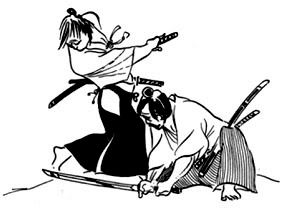
The Kenjutsu (the art of the sword) is recognized generally as militant art. It begins always with the sword unsheathed, already with an aggressive intention. The first historical systematic educations recorded of the Japanese long sword began approximately in 800 CE. Since that time, of around 1.200 styles (schools) were documented. Many practitioners of the kenjutsu began it question itself a comprehension more elevated would be able to to be obtained with the practical one and the study with the sword. Like this, the kenshi (swordsman) transformed to "art of the sword" (kenjutsu) in a "road of the sword" (kendo). Then the kendô arose, about the century II.
Kenjutsu is considered a bujutsu classical (art of the war or martial art), being formulated well before of the reform of Meiji (the classic/modern one, that divides the line). The ryu classical of the kenjutsu (schools) tende it be completely secret in what concerns the practical one of its techniques, being a lot closed persons of outside of the Art of the Bugei. The ryu classical of the kenjutsu is the more near to the classical training of the warrior in the modern world. The examples are Yagyu Shinkage Ryu, and Tenshin Shoden Katori Shinto Ryu.
The utilization of the Katana, inside the clothing of the Kenjutsu traditional, consists generally of the hakama, in the keikogi and of the obi (streak).
The Kata (sequence of movements formulated or exercises) is the usual way of learn how the tangled movements demanded. Initially practices-itself individually, but is able to be practiced in pair or to even with multiple individuals. The tool-standard of the practical one is to bokken (sword of wood simulated) or a real sheet. The real cut, and the strike of the sheet against bundles tied and stems of bamboo, called of tameshigiri, give to the practical one more advanced of the ryusha (practising of a style) the real impact of the sheet of meeting to an aim.
Generally (but not always) in Japanese martial arts, the objectives of the "Of The" healthy for improve the interior, while the of the "jutsu" concentrate in teach the techniques of the war. It notices that this is a modern convention, does not something that reflect the historical use of the suffixes: what do we call now of kenjutsu is able to a time to have been used like the kendo. The convention of the terminology of jutsu of the such as is used in the west was popularized in its bigger breaks by Draeger. They defined terminologicamente, the art of earn real fights with real swords is kenjutsu. The preliminary objective of the kenjutsu is victory about opponents; the preliminary objective of the kendô is going to improve with the study of the sword. The kendô has also a strong aspect, with the big championships, watched greedy by the Japanese public. Like this, the kendô can be considered the Japanese philosophical sporting aspect.
In we will have of learning, the kenjutsu has a more complete curriculum. In the kendô, the need limits to scale of the techniques and of the aim. The practitioners of kenjutsu do not use generally the shinai in the training, preferring use bokken (swords of wood) or kataná (swords of steel) in order to preserve the techniques of the cut of the real fight of the sword. The training of Kenjutsu consists of practice to technical of the cut and perform the katá with the partner. By reasons of security, to practical free is rarely deed with kataná.
Kenjutsu - Historical
The history of the Japanese culture is full of episodes with the sword. Of fact, one of the three objects of sacred possession of an emperor, was the sword. The others two are the jewel and the mirror. The old legend of the xintoísmo says that a divinity dove a kataná in the sea and of the drops d' water that dropped of the tip were born the islands of the Japan. A cynic characterized the history of the Japan as many peoples that fight about little land. The sword and his use were facts forms by the history of the land and of his peoples. First, the sheet transformed itself a very efficient weapon of the cut, uniform of meeting to the armor. And two, his distribution changed, what permitted the ascent of a distinct style of the Japanese sword
In order to cultivate and improve the sword, as a weapon and like a form of art, two circumstances were demanded. First, it should have a sufficient stability for that manufacturers could practice his commerce without risks of market. The majority of the legendary battles of the Japanese folklore occurred in this period of time. In the beginning, the battles were between the race that we call now of Japanese, and the native peoples, called Ainu or Emishi. The battles were furious, and the leader of the army of the emperor was called of Taishogun, shortened later for Shogun, the last military authority of the Japan.
Later, the war of Gempei between the Taira and the clans of Miyamoto, documented like the wars between the clans that make an effort for the supremacy. Miyamoto earned occasionally, putting the claim to the title Shogun in his leader; after which the emperor declared that only the descendants of Miyamoto would be able to put the claim to the title.
In the end of the I century, three big generals raised itself, each an in the succession, and everybody unified the country under a leadership; Oda Nobunaga, Hideyoshi Toyotomi, and Ieyesu Tokugawa. When Tokugawa knocked down his last rival in the battle of Sekigahara in September of 1600, unified the country under an I govern by the first time in 800 years. Because Ieyesu would be able to claim the blood of Miyamoto, claimed also the title of Shogun for itself own and his heirs. His it was, Kamakura moved the center of the government for Edo, called today Tokyo. In the 268 following years, the Shogunato Tokugawa governed the land in peace.
And with peace, came the decline in the practical one of the sword, however small traditionalist groups refused it be forgot the old ways. The writing of these kenshi are cited before the end of the day as examples of big works. Miyamoto Musashi and Tsunemoto Yamamoto are considered still as the kensai (holy of the sword) in the Japanese folklore. With the big peace, came the warrior or the ronin unemployed (literally "wave the man"). Tokugawa tried to convert warriors in bureaucrats, for function the government. The Tokugawa may have governed in the peace, but bound a fist of iron for do like this. To part of his way control the stream of the Japanese society should establish a system of castes.
There were four classes of the peoples in descending order, in samurai (royalty), in farmers, in artisans, and in merchants. Those that were traditional warriors of farmers would not be able to use no of the most long swords, only the samurai would be able to erode the official emblem of the office, the sword. The Tokugawa closed also the back of Japan to the exterior world, performing all of the intruder and permitting only that a small only console nearby Kagoshima in the south be visited a time a year by merchants of Portugal.
In the gallery, the sword and his practical continued it decline during this time in a gradual way. In 1854, the ships of the Americans inscribed the bay of Tokyo and required to negotiate open with the Japan.
But about the Tokugawa was exercised pressure of internal necessities for turn the game. To only way that the Tokugawa would be able to see for preserve any measure of control limited should return the power to the emperor. And like this in 1868, the Tokugawa came down his position, returning the power to the emperor Meiji, beginning the reform of Meiji. The Japan had incorporated the industrial return. The samurai disbanded, officially, by the emperor Meiji. Later, they were excluded of the official emblem of the office, erode of the two swords, in 1877. This gave the ascent to the last big battle, the rebellion of the Satsuma in December 1877 to January 1878. The Satsuma refused to obey and fought with the army recruited of the government (with modern weapons) in Kagoshima in the south. The samurai dead and his martyrdom transformed itself a symbol for the practitioners.
The modern period of the sword was characterized by a bigger decline and more uniform. The Samurai was forced it give exhibitions to end try to earn money.
The arts of the sword are divided in diverse ways. First it is for the kind, ken or the iai (called sometimes batto). Also at the same time divide itself by the origin, the three families of arts of the sword; Styles of Muso ("deflate"), of Kage ("shade"), and of Shinto ("new sword"). Some kinds mix this, it depend on the origin and of the application. Inside each kind are the three styles.

 Trả lời kèm Trích dẫn